On March 22, 2022, Yvan Colonna was beaten to death in prison for his political views. He was a Corsican nationalist serving life in prison for his assassination of Claude Érignac, a top French official in 1998. Massive protests erupted as a result wanting “Freedom for Corsica”. But why? Why does Corsica have such a grudge against France and its government? Why do the people of the island care so strongly for their heritage? Why was Colonna killed in prison in the first place? The answer to this can be found in its language.
The video shows protesters actively demanding for freedom in Corsu(the Corsican language) while insulting the police, demonstrating the Corsicans’ hate of the French government and love for their own culture.
Corsica is an island located in the Mediterranean Sea, 105 miles south of France, 56 miles from Italy, and 7 miles from Sardinia(island owned by Italy). It has a population of around 350 thousand individuals and is predominantly roman-catholic.
A Brief History
Corsica has a very diverse past. First being inhabited by the Corsi(an ancient group of people), then taken by the Greeks, then the Italians, then being swapped between the French and the Italian until the modern day French occupation. The island has certainly been hurt by its colonial past. Not only because it has been historically exploited for resources by both Italy and France which has slowed its economic development(has not stopped it entirely), but it has also led to fading of its original language(Corsu), which to this day France still insists on making a reality. Certain laws have been implemented to supress it, an example of this would be the Ferry Laws of 1882. These mandated that all Corsicans be educated in French. The fading of the language only got worse after WWII. Before the war 85% of Corsicans knew Corsu, afterwards, only 30%. However, despite taking this dip, there have been many attempts to revive the language even in the French government. The Deixonne Law of 1951 for instance, allowed the Corsican language to be taught in schools, starting a major turning point for the language as a whole. Since then, protests in the 1970s/1980s followed by current movements today have given a new life to Corsu despite efforts to to eradicate it.
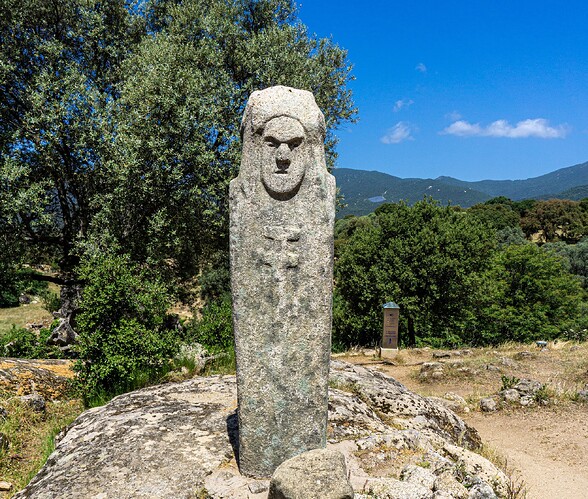
Ancient Corsican warrior statue at the Prehistoric station Filitosa. Sollacaro, France
The picture above helps show how much Corsicans care about their history, as this ancient statue is well preserved and is a modern day tourist attraction.
Looking back at the island’s history we can see why Corsica feels the way it does about France. It was exploited for resources by both France and Italy harming its economic growth, and on multiple occasions France has tried to get rid of their language. These attempts being as recent as 2022 when French courts deemed it illegal to speak Corsu in government. The island simply wants to preserve its language, and the French government is trying to stop that.
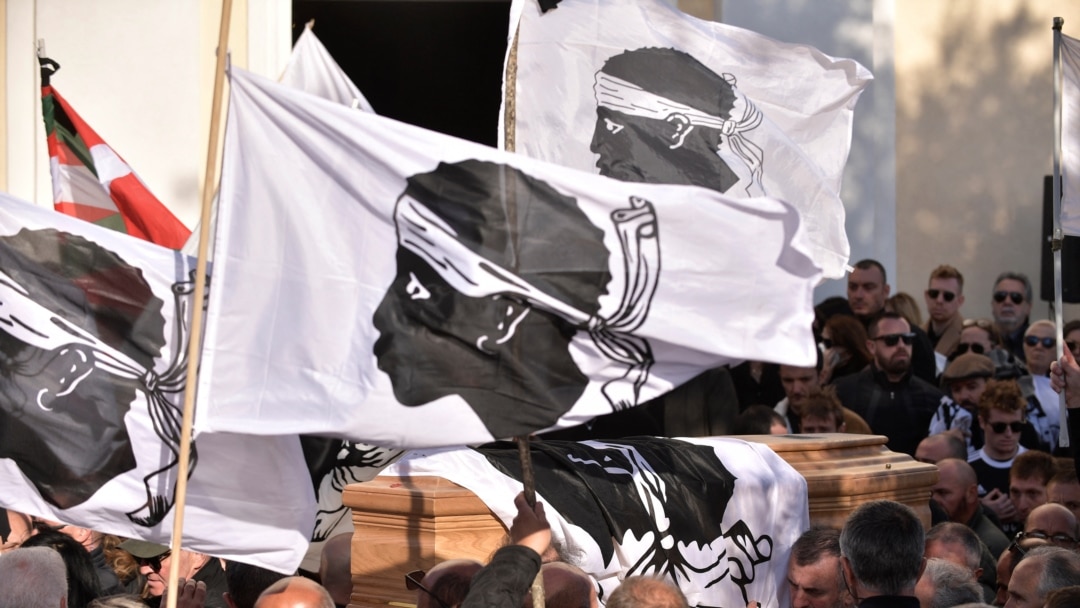
Corsican protesters holding up Corsica’s flag in response to the murder of Yvan Colonna, 2022
This picture displays the Corsican flag. The man on it is meant to represent independence and freedom, showing the peoples’ desire for self-determination and anger with the government of France.
The Corsican language, Corsu is a vital part of the peoples’ culture and heritage. Many traditions have Corsican names such as the Fiera di U Casgiu(the island’s cheese making tradition). Corsica also does a lot to teach other languages from around the world. For example, there are quite a few immersion centers such as Practilingua to teach people not only French and Corsu, but other languages such as English, Spanish, Italian, and Portuguese. By this logic it would also be very cruel to erase the language since the people who speak it are trying hard to learn French and other languages spoken around the world.
Hypocrisy, Plain and Simple
France has 75 regional languages. Knowing this you would think France would care to respect them given the large amount of them, but no, the French government continues to assert that the language of French is the official language of the republic. The French constitution does back this up. In article 2, it is mentioned that French is to be the language of the country.
The language of the republic shall be French. -Article 2, French Constitution
While this does assert that French is the “official” language of France, looking deeper into the constitution we can see statements that still suggest that we should have respect for regional ones. Article 75-1 says that regional languages are an important part of the nation’s heritage.
Regional languages are part of France’s heritage – Article 75-1, French Constitution
This directly claims that France should respect the languages of each of its regions, something the current French government does not seem interested in doing. It is because of this that the people of Corsica are so mad at the French government, and are reasonable in being so. France is being quite hypocritical.
In Conclusion
It is both cruel and hypocritical for France to attempt to erase Corsu. The language is a big part of Corsica’s culture, the people there still learn French along with many other foreign languages, and the French constitution actively states that regional languages like Corsu should be respected as part of the country’s heritage. It is for these reason that the language should be valued and cherished.
Corsica: Religious Music of Oral Tradition, performed by Various Artists (Smithsonian Folkways Recordings/Audivis-UNESCO, 1977), 54 mins
Debré, Michel, and Charles De Gaulle. “French Constitution.” Constitution of 4 October 1958, French Government. Conseil Constitutionnel, www.conseil-constitutionnel.fr/en/constitution-of-4-october-1958. Accessed 2 Dec. 2025.
Image describing the location of Corsica on a map. 25 July 2023. BBC News, www.bbc.com/news/world-europe-30393118. Accessed 3 Dec. 2025.
MENDES, ALEXANDER. Countervocalities: Shifting Language Hierarchies on Corsica. Liverpool University Press, 2023. JSTOR, https://doi.org/10.2307/jj.2862487. Accessed 2 Dec. 2025.”Regional and Minority Languages in France.” Library of Congress, Congress, guides.loc.gov/french-literature-and-language-learning/regional-minority-languages-france. Accessed 1 Dec. 2025.